Are you considering rolled rubber floors for your home, office, or commercial facility? Before making a choice and spending money on rubber flooring, ensure that the best product is being purchased.
At Greatmats, we want all of our customers to be fully informed on their flooring choices and the unique advantages of each flooring option, ensuring they can make a confident purchasing decision. With that in mind, let's look closely at rubber flooring to see if your space would be enhanced by this surface material.
What are the Best Conditions for Rubber Flooring?
Rubber flooring rolls can be laid in many different areas, but in general you'll find that flat, dry, indoor spaces are best for rubber floors. Rubber is bendable and can flex, but is still stiffer than some other flooring options. If the flooring is laid over uneven cr
 |
| Surface for installing rolled rubber |
acks or gaps, it can create bulges and ridges on the flooring.
Rubber mats and rolls also work best a dry area, specifically underneath. Even though rubber mats do not absorb water, moisture that becomes trapped under the flooring can lead to mold and mildew growth. Because of this, perforated tiles are the better choice for wet areas.
Flat, dry and hard; those are generally the best conditions for your rubber flooring.
When Should Subflooring Be Used for a Rubber Floor?
One of the most important questions we get about rubber flooring revolves around subflooring. Many customers ask when to use subflooring, and if they should, what type is best for their use case.
Many customers choose to use subflooring to protect the surface underneath. For example, if you are laying rubber floors over ceramic tile, you need a subflooring to keep the tiles from cracking or breaking. In most case cases, using a protective, cushioning flooring material is the best solution when laying the rubber over ceramic tile.
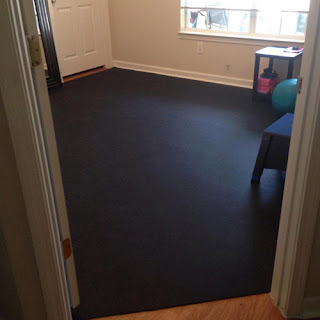 |
| home gym flooring over concrete |
Similarly, if the rubber flooring is going to be installed over hardwood, we recommend using a subflooring. With hardwood we recommend a layer of craft paper to stop the black coloring of rubber mats and rolls from seeping into the hardwood, staining the material. A layer of paper will keep the hardwood protected from staining so you have a gorgeous surface if you decide to remove the rubber.
You may also need a subflooring if you are installing the rubber floors over a concrete slab that contains moisture or has moisture underneath. This layer is there to keep water from being trapped underneath the floor.
In all cases, it's important to talk with our staff to see if a subfloor is needed.
When Should it Be Avoided?
Rubber flooring is very versatile and reliable, but there are some areas where you should avoid using it. Typically, whenever installing the flooring, it’s important to place the flooring on a flat, even surface. Rubber can contour to ridges and inconsistencies, but this is not ideal for permanent placement, as it will result in bulges and wrinkles.
Rubber flooring should also be avoided when the surface the flooring will be installed on has significant gaps. For example, decking, which has gaps between the deck boards, is not a good location for rubber flooring, as you will have ridges and seams in the floor. Rubber flooring should also be avoided with tile flooring that has deep grout gaps.
Installing Rubber Floor Over Different Surfaces
Flat Concrete
Of all the potential surfaces for installing rubber, a flat concrete surface is probably the most ideal. Flat concrete is great for rubber floors, providing a consistent, flat, long-lasting foundation for the rubber, which creates great long-term quality. Rubber flooring needs to be placed on a solid, level surface, making concrete a perfect choice for rubber flooring to be installed on. However, you want to make sure that there is not a high level of moisture within or underneath the concrete, as this can seep upward, become trapped between the concrete and rubber, and cause mold problems. If moisture is present, a full-spread adhesive is recommended. It will act as a waterproofing measure for the concrete.
Indoors, rubber is an excellent product, even for damp areas like jacuzzi or indoor pool decks. For outdoor pools and hot tubs Greatmats offers other flooring options that are better suited than rubber flooring.
 |
| rubber flooring installation |
While rubber flooring is perfect for flat concrete slabs, it must be glued down if you are installing it over concrete steps. When installed on steps, the rubber flooring can move underfoot, making a potentially dangerous safety hazard for those using the stairs. Therefore, it's better to use an adhesive to keep the rubber flooring in place.
Ceramic Tile
Another surface that is good for rubber flooring is ceramic tile, but because of the fragile nature of these materials, it may be necessary to include some sort of protection and subflooring. Even the highest quality ceramic tiles are very brittle and can crack under heavy foot traffic or if weights are dropped. This is particularly true if the rubber flooring is being used without a subfloor or if thinner rubber flooring is being used.
If the rubber flooring is installed over ceramic tiles, some follow through may be noticeable, in addition to grout lines if the grout is particular deep between the tiles.
Despite the challenges, ceramic tile remains a popular choice for flooring surfaces. It may require a subflooring or padding to protect the tiles or prevent lines or creases, but our helpful staff can work with you to select the right flooring and accessories to make your floor look fantastic, all while protecting the ceramic tile underneath.
Flat Hardwood
Hardwood flooring is a beautiful flooring surface for homes or offices. However, if you need to cover hardwood, rubber flooring is actually a great choice. But if installing rubber flooring over hardwood, a protective paper underlayment needs to be installed between the rubber and hardwood, particularly with high-quality hardwood.
For all rubber flooring products, we recommend a craft paper underlayment. This paper underlayment prevents the black flooring of the rubber flooring from seeping into and staining the hardwood. With the paper underlayment, there is no transfer of color, so if and when you decide to lift the rubber flooring, you still have an elegant, warm wood surface.
While rubber flooring is ideal for indoor hardwood floors, it is not the best option for covering outdoor wood decks. For use over a wood desk, modular perforated tiles are a better option than rubber flooring because they allow rainwater to drain through the tiles.
Rubber is also not ideal as a temporary protective surface for large gym floors due to its weight. In this case, we recommend a protective vinyl sheet. We offer 10-ounce to 27-ounce weight sheet vinyl that is designed specifically for large gym floorings. This vinyl flooring is the best option for basketball, volleyball, and racquetball courts, in addition to school or community-center gyms.
Carpet
We do not recommend using rubber mats or rolls over carpet. When you place rubber rolls over carpeting, the material will bunch up, creating tripping hazards and giving the surface an inconsistent, ugly appearance. Rubber that is installed over carpet can damage the carpet, creating more problems for the flooring.
So if rubber flooring should not be used for carpet, what is a better option? In most cases, we recommend a raised interlocking tile that gives good grip between the carpet and the surface material. Interlocking tiles, particular ones made from harder plastics, there is less of a possibility of bunching and other issues. We also have 9/16-inch thick PVC tiles that is are excellent options for use over carpet.
Outdoor Surfaces (Grass, Dirt, Rock, Etc.)
Using rubber rolls over ''natural'' outdoor surfaces, such as grass, rock, and dirt is not recommended. As rubber flooring rolls are not perforated, rain water will not drain off the rolls unless there is a slope that allows for drainage. Essentially you'll have water pooling and puddling on top, which can be a nuisance.
A single roll of rubber flooring could be used on top of grass, rock, or dirt as a runner, but this is not an ideal use case.
 |
| rubber floor installation |
Greatmats carries many outdoor rubber flooring options that provide great traction and support. Outdoor rubber flooring most commonly comes in the form of ties or pavers. If you're simply looking for a decorative touch, one of the best options is the Flexstone Rubber Paver Tiles, which are great for walkways, gardens and landscaping features.
Rooftops
We often get questions about rooftop flooring surfaces. Customers often want to turn their rooftop areas into a useable space. Assuming the structure has enough strength and integrity for foot traffic, there are a few options, but rubber flooring rolls are not generally not recommended.
Rubber flooring isn’t a great option on rooftops, particular on concrete rooftop surfaces, because of mold. Mold is most often found in damp areas where water has been trapped. When you lay down rubber mats or rolls over a concrete surface, you create the perfect location for mold. Installing a flat rubber product over a membrane will most likely lead to mold. This is why Greatmats does not recommend rolled rubber flooring for rooftop surfaces.
Like most outdoor areas, it's best to have a perforated top or other method for drainage, which allows water to move underneath, provides conditions for evaporation, and results in less chance for mold.
If a rubber surface is needed for a rooftop patio, the 2 inch thick Sterling Roof Top Tile is the best option as they have a raised base. However, proper drainage precautions should be taken in the subsurface as these rubber tiles are porous in nature.
Find the Perfect Flooring for Any Surface
Need a unique surface to be covered? Please contact our friendly staff and we'll reach out to you with more information about all our fine products. We have the knowledge and experience to provide accurate advice on your specific flooring needs, so contact us today!
Greatmats has specialty flooring options for everything from flat concrete in a basement to outdoor decks and patios.
 |
| installing rubber flooring over concrete |


